Ensamble mezcal is mezcal made with more than one agave species. Two or more agaves are produced in a single batch, which is then cooked, crushed, fermented, and distilled together. If agave species are distilled separately and then mixed, it is called a mezcla or blend.

What “Ensamble” Means on a Mezcal Label
On a mezcal label, ensamble tells you that more than one agave species was used. The bottle may clearly say “ensamble,” or it may simply list two or more agaves.
The label does not always indicate whether those agaves were produced together. When a bottle gives batch notes, look for cooked, crushed, fermented, and distilled together.
If it lists only agaves, it confirms it's a multi-agave mezcal. It may be an ensamble in the strict sense, or it may be a mezcla or blend made from separate distillates.
Ensamble vs. Mezcla or Blend
Mezcla means mixture in Spanish. In mezcal, the word is used when separate batches or finished distillates are mixed later in the process.
Ensamble happens earlier. Two or more agaves undergo the same production run, during which they are cooked, crushed, fermented, and distilled together.
Mexican mezcal rules do not define ensamble as a separate category. Some brands use the term broadly to refer to multi-agave mezcal, so the label does not always indicate exactly when the agaves were combined.
| Term | What it usually means | When the agaves are combined | What the label can tell you |
|---|---|---|---|
| Ensamble | Mezcal made with more than one agave species. | The agaves are produced in a single batch. | Multiple agaves are used, but the exact process may still vary. |
| Mezcla / Blend | Mezcal batches or distillates are mixed later. | Often after separate production or distillation. | The producer or importer needs to explain the process. |
| Single-agave mezcal | Mezcal made from one agave species. | One species is used for the batch. | Easier to connect the bottle to one maguey name. |
Is Ensamble an Official Mezcal Category?
Ensamble is not an official mezcal category under NOM-070, the Mexican standard that defines how mezcal can be made and labeled. The official production categories are Mezcal, Mezcal Artesanal, and Mezcal Ancestral. Ensamble tells you that more than one agave species was used, not which legal production category the bottle belongs to.
How an Ensamble Mezcal Is Made
A strict ensamble begins before distillation. The producer works with more than one mature agave species in the same production run.
- The piñas, the dense hearts of the agave, are cooked in a single batch.
- The cooked agaves are crushed together or brought together before fermentation.
- Fermentation occurs with the agaves during the same production run.
- The fermented liquid and fibers are distilled together.
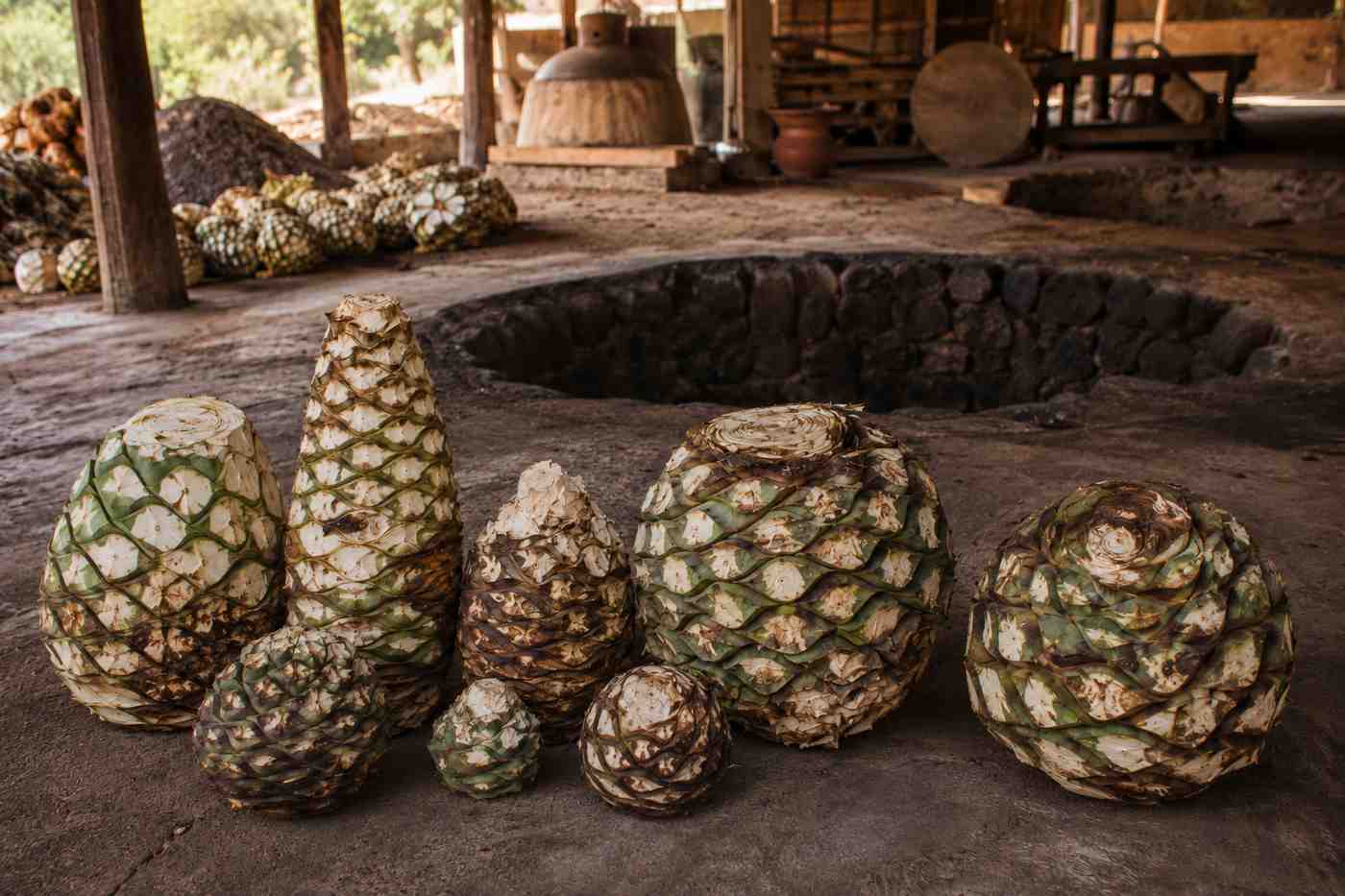
That sounds simple until the agaves are in the oven. Espadín usually has a rounder, more uniform piña. Karwinskii agaves such as Barril or Cuishe can be taller and more irregular. Tobalá is smaller.
Different shapes and masses cook at different speeds. A mezcalero has to arrange the oven carefully when roasting several agave species together.
Some producers combine agaves later in the process. One batch may be roasted separately and brought together for fermentation. Another may be distilled separately and blended afterward. That is where ensamble and mezcla can become confusing.
Why Producers Make Ensambles
Mezcal was not always built around single-agave bottles. In many traditional productions, the mezcalero worked with the mature magueys available at that harvest.
If Espadín, Barril, and Mexicano were ready at the same time, they could go into the same batch. This older field-blend logic is sometimes described as mezcal del campo.
Mexico is the center of origin and natural diversity for magueyes, and mezcal agaves grow across very different landscapes. That diversity is one reason multi-agave batches make sense in traditional mezcal production.
Harvest timing and small quantities
Wild agaves do whatever they want—they grow at different speeds and pop up randomly on hillsides. A mezcalero might hike out and find only five mature Tobalá plants.
That is nowhere near enough to fill a traditional roasting pit. By tossing them into the horno with whatever Espadín is ready, they avoid wasting time, firewood, and labor on a tiny batch.
Batch logic and oven efficiency
An underground oven is essentially a giant steam room that requires a specific number of agave hearts (piñas) to maintain its heat.
If a producer harvests 3,000 kg of rare Tepeztate but their pit holds 5,000 kg, they can't just leave it half-empty. They will top it off with Karwinskii varieties like Madrecuixe to get the perfect weight for a clean, even bake.
Flavor direction and balancing
Every agave brings something different to the table, and mezcaleros use that to change up the taste. Take Espadín—it is basically the workhorse.
It has tons of sugar and gives you a solid, sweet baseline. But if you throw in some wild Arroqueño, you suddenly get those rich floral smells.
Then, adding Cuishe changes things again by cutting right through the sweetness with a dry, stony, and super earthy vibe.
Local practice and cultural heritage
In places like Santa Catarina Minas, clay-pot distillation is still the big thing. But those old clay pots do not hold much, so you naturally end up with very small batches.
Making ensambles is not a trend here; it is just how families survived for generations. They do not care about isolating one specific agave type.
To them, the goal is simply bottling whatever ready maguey happens to be sitting in the field that morning.
What Does It Taste Like?
There is no single ensamble flavor. The taste depends on the magueys in the batch, the village, the roast, the fermentation, and the still.
Bozal’s Ensamble comes from Miahuatlán and Etla, Oaxaca, and uses Espadín, Mexicano, and Barril. In this mix, Espadín brings wet earth, smoke, and wild flowers. Mexicano moves it toward herbs and earth, while Barril adds citrus, green pepper, floral notes, and a creamy banana edge.
Mezcal Vago’s Ensamble en Barro goes in another direction. It lists Espadín, Barril, Coyote, Sierra Negra and Mexicano. The agaves are hand-mashed and distilled in an olla de barro, a clay pot still.
That clay-pot batch leans toward wet soil, dried stone fruits, and honey. It also varies from batch to batch, which is why ensemble should not be treated as a single fixed flavor style.
A copper-still ensamble from Miahuatlán or Etla will not taste the same as a clay-pot ensamble from Sola de Vega. The word ensamble tells you the mezcal is multi-agave. The rest of the label tells you why it tastes the way it does.
Is Ensamble Mezcal Better Than Single-Agave Mezcal?
No. Ensamble is not a quality grade.
A single-agave mezcal is easier to read because one maguey leads the batch. You can focus on what Espadín, Tobalá, Cupreata, or Barril does when the whole bottle is built around that plant.
An ensamble shows a different kind of work. The mezcalero has to move several agaves through the same roasting, fermentation, and distillation. Different shapes, sugars, and fibers do not behave the same way.
The better question is what the bottle is trying to show. A single-agave mezcal can teach you one plant. An ensamble can show how several mature magueys work together in one run.
The Practical Way to Think About It
An ensamble label tells you that more than one agave is in the bottle. It does not always tell you exactly when those agaves were combined.
In the stricter sense of mezcal, the agaves undergo the same production process. Mezcla, or blend, refers to a later mix of separate batches or finished distillates.
A bottle labeled Ensamble Espadín, Barril, and Mexicano gives you the first clue. The next clues are the producer, place, batch size, still type, and any notes on how the mezcal was made.